- TESIGN / RADAR
- Solar Wanderer
Solar Wanderer
Real-time 1:1 solar system, no install
WHO USES ITTeachers and students · Astronomy enthusiasts · Web 3D developers
Use in the browser
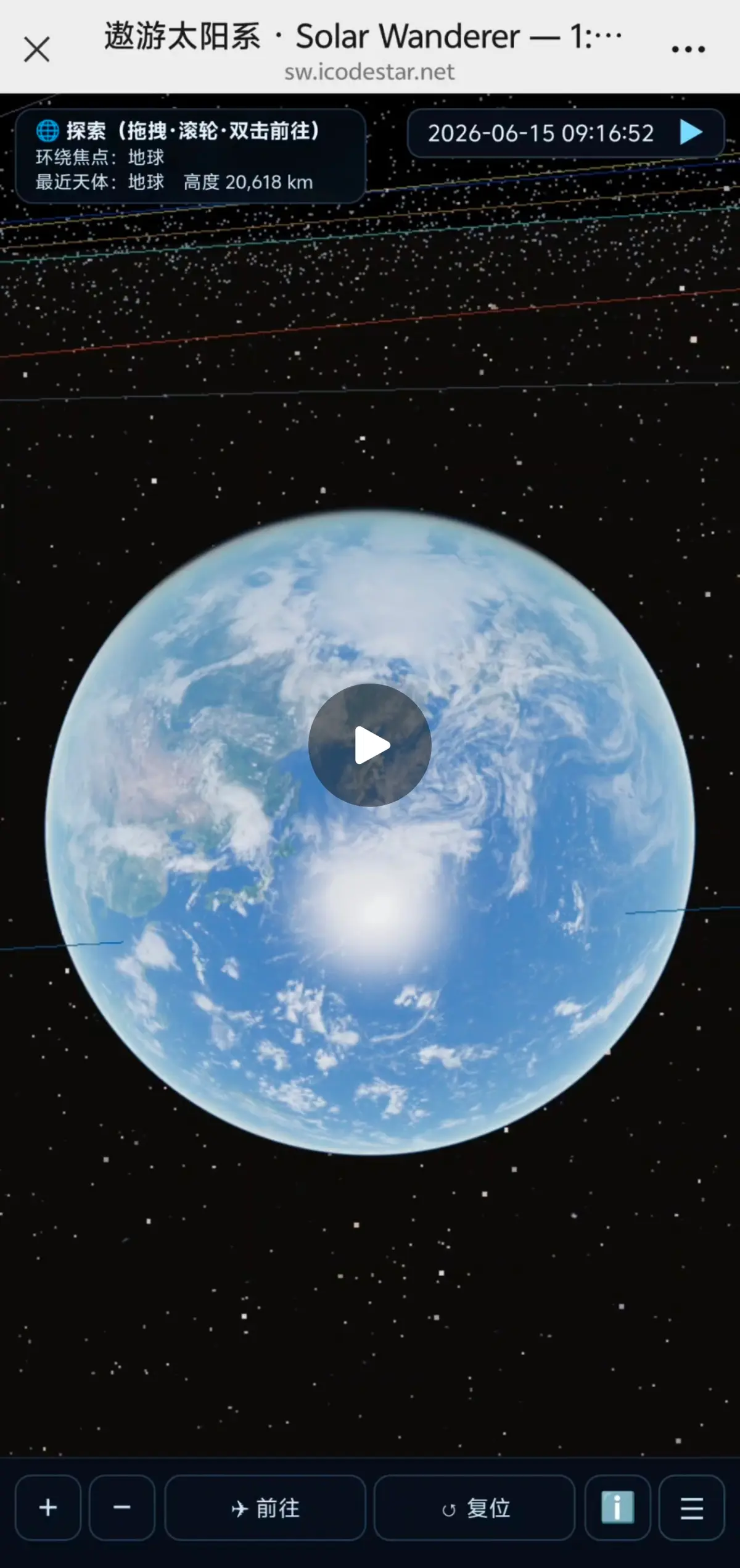
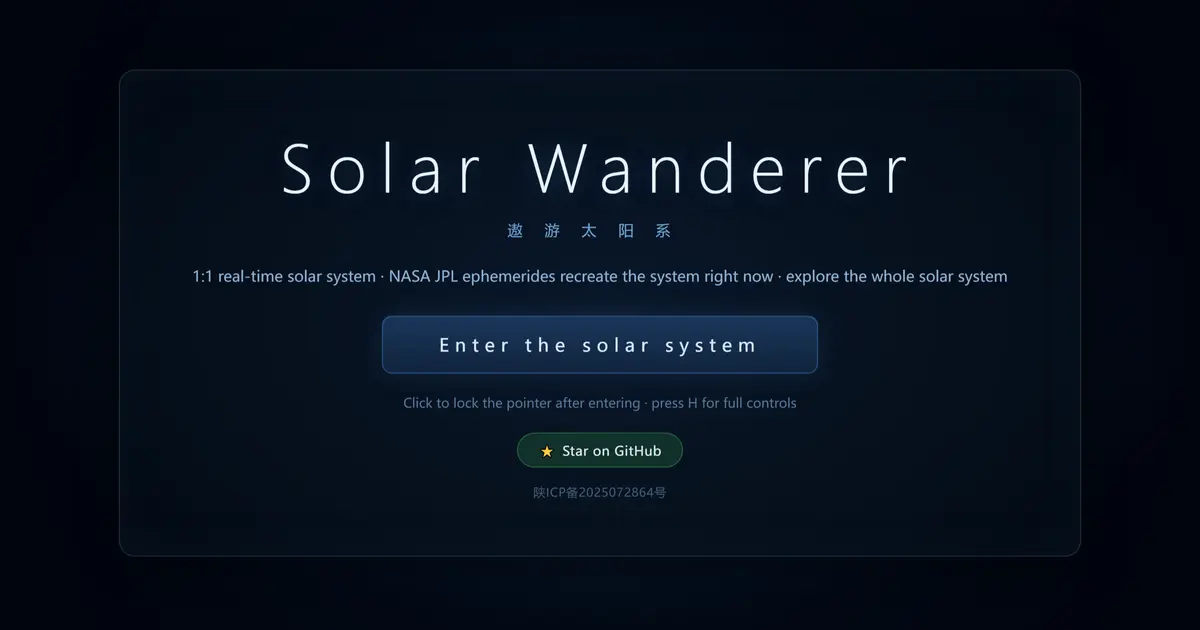
1:1 real-time solar system in the browser, driven by NASA JPL ephemerides; phone-friendly
739 stars · checked on GitHub GitHub check 30 h late · no 7-day star increase observed (GH Archive) (as of )
BACK CATALOG
TESIGN TAKE
Publishing an accuracy table and a verify script is what separates this from solar system apps that only look right.
AT A GLANCE
- LICENSE
- MIT
- USAGE
- Use, change and redistribute, commercially too. Keep the notice.
- LANGUAGE
- JavaScript
- PLATFORM
- web
- ACTIVITY
- last commit 24 days ago () · latest release v2.2.0 () · 6 releases
- COMMUNITY
- 4 contributors · 1 open issue (incl. PRs) · made by: an individual
- SOURCES
- GitHub
- OPEN SOURCE
- YES
- FIRST SEEN
- CATEGORY
- EDUCATION · SCIENCE
A summary, not legal advice.
WHY IT MATTERS
Space apps usually make you choose between accuracy and immersion; this one puts both in a web page. The README's accuracy table lists planet positions within 0.0007°–0.074° of NASA JPL Horizons, the Moon at 0.12° and 21 moons within 0.22° after ten days, and `npm run verify` re-checks against Horizons live. It runs at true 1:1 km scale from the Sun to the 100,000 AU Oort Cloud, ships about 200 kB of gzipped JS and supports phone touch.
BUILD FROM THIS
- The ephemeris layer is pure functions testable in Node, so it can feed your own astronomy visualisation or lesson material, and the roadmap's guided tours and courses are open for education content. MIT allows commercial use; the textures carry their own CC-BY-4.0 and similar attribution terms.
WHO IT'S FOR
- Teachers and students
- land on the Moon and look up at Earth, get a feel for scale
- Astronomy enthusiasts
- today's real planet positions, 28 TNOs and 4 comets
- Web 3D developers
- floating-origin rendering and a logarithmic depth buffer at 1:1 km scale
START IN 5 MINUTES
# # No install: open https://sw.icodestar.net
# git clone https://github.com/hyqzz/Solar-Wanderer.git
# cd Solar-Wanderer
# npm install
# npm run dev      # → http://localhost:5173
CAVEATS
- Licence MIT (code). Textures come from Solar System Scope (CC-BY-4.0), Steve Albers SOS and NASA JPL Photojournal (public domain), each with its own terms.
- Needs a WebGL2 browser. Free, no account or backend. Interface in Chinese and English per the homepage.
- Moon position uses a truncated ELP at 0.12° error. Real DEM terrain, eclipse shadows and VR are roadmap items, not shipped. 737 stars.
RECEIPT
- FIRST SEEN
- AT SOURCE
- KEPT
- CREATED → FIRST SEEN
- 93d
- SOURCES
- GitHub
- ◌ BACK CATALOG
- Reconstructed from archive data, not a live discovery.
The same facts in machine-readable form — View as Markdown · JSON
SIMILAR TOOLS
Up to five from EDUCATION by ★ total: edited entries first, then repository cards; this entry is highlighted. Drawn from the same stored snapshot as the rankings — a comparison, not a recommendation.
| IMAGE | NAME | ★ TOTAL | ▲ 7d | LICENSE | PLATFORM | LAST PUSH |
|---|---|---|---|---|---|---|
 | Solar WandererReal-time 1:1 solar system, no installTHIS ENTRY | ★ 739 | — | MITpermissive | web | |
| novuhq/novuCARD | ★ 40k | — | Licence unconfirmedunconfirmed | — | ||
| ankitects/ankiCARD | ★ 30.5k | ▲ +22 | Licence unconfirmedunconfirmed | — | ||
| zyronon/typewordsCARD | ★ 10k | ▲ +15 | GPL-3.0copyleft | — | ||
| we-promise/sureCARD | ★ 9.9k | ▲ +8 | AGPL-3.0copyleft | — |
ALSO WORTH SEEING
TIMELINE
- Repository created
- FIRST SEEN BY TESIGN ◌ BACK CATALOG